Beck indeed

While I pointed out the P&O archive a while back, I also said that I wanted to come back to it.  And there’s one very good reason for doing so; his name is Richard Beck.

Richard Beck Vintage P&O poster orcades 1937

The handful of posters that he produced for P&O are that rare thing, home-grown British modernism.  And it looks first class.

Orient Line Cruises to Norway vintage travel poster Richard beck 1937

Beck seems mainly to have been active in the late 1930s.  All these three posters for the Orient Line apparently date from 1937.

Orient Line Vintage travel poster Richard Beck 1937

At about the same time, he was also working for London Transport – these two panel posters were designed in 1935.

August Bank Holiday vintage London Transport poster Richard Beck 1935

Beckontree Park vintage London Transport poster 1935 Richard Beck

But even before the start of World War Two, Beck seems to disappear from the record for a while.  He next pops up as the designer of this.

Richard Beck vintage poster 1956 Olympics Melbourne

For a change, though, it’s possible to account for all of this, because there are a couple of decent biographies of him out there on the web – the best here.

To start with, his early work looks as European as it does, because he studied at the Blocherer School in Munich, so was far more exposed to European modernism than the average British designer.  Hence his uber-modernist designs for London Transport, like this leaflet.

Richard Beck leaflet for London Transport 1930s

Secondly, he then disappears because he went to the other side of the world.  In 1939, he went to New Zealand as design consultant for the British Pavilion at the Wellington Centennial Exhibition.  And he never came back; instead he migrated to Australia, serving in the Australian Imperial Force during World War Two and then setting up a design consultancy in Melbourne when the war was over.

Mural on Hosies Hotel Richard Beck Melbourne Olympics 1956

He did very well, too, designing not only for the Olympics (the mural above still exists in Melbourne, although it was apparently once much brighter) but also for a whole range of clients and companies, including stamps for Australia Post and the new decimal currency.  And Australian wine too.

Richard Beck wine design 1950s

Beck did well for himself.  But one of the reasons I find his story so interesting is that he wasn’t the only one.  Just as British design after the war was revitalised by an influx of European designers, it seems that Australian design was also very much shaped by immigrants.  Pieter Huveneers designed for at least as many Australian institutions as Richard Beck.  Did the world of British graphic design seem too closed and old-fashioned for these designers, or was the appeal of a new sunshine life simply so appealing after the rigours and horrors of World War Two?  We may never know.  But if there’s an Australian Crownfolio reading this who has some of the answers, I’d love to hear from you.


Posted in designers, posters | Tagged , , | 4 Responses

Save Your Bit

I’ve been rummaging around in the VADS picture archives again, and to my delight have discovered that the Imperial War Museum have uploaded many, many more war posters recently.  I’m not even a quarter of the way through them yet, but this set did particularly amuse me.  They start off fine, even if I don’t actually know what the first one is on about.

Burn Your Cinders vintage WW2 Board of Trade propaganda poster VADS IWM

Even the next one seems fairly reasonable, if a bit depressing.

Fewer Hot Baths vintage WW2 Board of Trade propaganda poster VADS IWM

But they won’t stop there, oh no.

Go To Bed Early vintage WW2 Board of Trade propaganda poster VADS IWM

And although I can find it funny now, it probably wasn’t then.  From this distance it’s easy to rhapsodise over the Blitz Spirit and everyone pulling together, but sometimes the Second World War must have felt like really grindingly hard work.  Especially when you were being ordered about by posters like that one on every street corner and in every shop.  It would have been enough to make me stay up late out of defiance.  Perhaps it’s fortunate that they weren’t reliant on me to win the war.

Save Your Bit vintage WW2 Board of Trade propaganda poster VADS IWM

Posted in archives, posters | Tagged | 8 Responses

Some Decorative Drawings

Clearly I have the willpower of a small amoeba.  I write about something on here, but then I don’t just walk away, oh no.  I only have to go and buy it.  Like,  say, Motif, which I wrote about only last week.

Motif 3 art journal of brilliance front cover by John  Griffiths

The good news is that we didn’t get the whole set of thirteen for £650, just two for rather less than that.  One of which is the one above.  But it’s the right one, because it has the shopfront illustrations in it.  And they are, frankly, brilliant.

Motif 3 John Griffiths shopfront pictures Fratelli Camisa

That’s my favourite, not just because it is utterly bright and enticing, but also because I used to go there, sometimes, in my London days.  And look at the little dog peering out of the door.  But the other illustrations are just as wonderful too. Here is Cooks Fruiterers in Brighton.

John Griffiths shop front illustrations from Motif 3 1959

Pretty much all I can tell you about them is that they’re by John Griffiths.  Here’s his title page for the set.

Motif 3 shopfronts by John Griffiths title page

Now the style of these Decorative Drawings isn’t entirely surprising.  They could sit quite happily alongside the work of David Gentleman and Roger Nicholson from about the same time, as well as John Minton too; each part of the same neo-Romantic version of Britain in the 1950s.

Smiths Umbrella shop John Griffiths Motif 3

And in their love of the myriad heaps of objects to be found within British shops –  here cooks’ striped aprons and white jackets for waiters – these drawings have obviously been born out of Eric Ravilious’s High Street.

P Denny John griffiths Motif 3 work of brilliance

At the same time, though, Griffiths is very much doing his own thing.  This isn’t a representative High Street, rather a celebration of architecture and idiosyncracy.

Hyman waves shop front illustration John Griffiths Motif 3

In his championing of Victorian and Regency architecture, Griffiths is very much ahead of his time, along with pioneers like John Betjeman.

pooley chemist JOhn Griffiths illustration from Motif 3

But in his eye for the eccentric and quirky, he’s out on his own.  There are some great snippets of text accompanying the drawings.  The chemist above occasions the following comment:

Pooley the Chemist in Wimbledon Village took over what was a doctor’s house in 1825.  The manager almost apologised for the poor display in the windows and said they had lost their best jars in the war.  But what they have left are fine enough.

But it’s this which wins hands down, an animal costume shop off St Martin’s Lane.

Theatre Zoo John Griffiths Motif 3

He assured me it would be easy to change a lorryload of students into a cartload of monkeys.  A midget dressed in a bright red jacked with black and white check tights suddenly walked by whilst I was drawing the façade and I did wonder for a moment.

And there goes the midget, off on the right hand side of the picture.

Motif can tell me almost nothing about John Griffiths other than that he was born in 1926 and designed a mural and theatre for the Garden Section of the British Pavilion at the Brussels International Exhibition 1958.  Irritatingly, the internet can’t tell me much more.  He designed a poster, Rhubarb and Roses, for London Transport in 1965.

John Griffiths Rhubarb and Roses 1965 Vintage London Transport poster

As well as quite a few covers for Penguin Books in the late 1950s and early 1960s.

John Griffiths penguin book cover ripeness is all

John Griffiths Eric Linklater book cover penguin

But that’s it.  Does anyone else know any more than that?  I hope so.

Finally, an extra treat from Motif 3.  Reyner Banham is writing about new office blocks in London, including this one for Thorn Electric at Seven Dials.  I’ve been past it so many times, but had no idea it was by Basil Spence.

Reyner Banham picture Basil Spence office block seven dials with posters

But that, you won’t be surprised to learn, wasn’t what caught my eye.  Because here are some posters too, as they were meant to be seen.

Banham poster detail

Proof, as if any more were needed, that not all posters were ever design classics.  Although I think we could do with a few more along the lines of Beer – Best Long Drink in the World!

Posted in designers | Tagged | 11 Responses

Death and the Poster Designer

I’ve always loved the smiliness of Tom Eckersley’s posters.

Tom Eckersley vintage hastings travel poster
Hastings, n/d

Between the late forties and the mid 1950s, his work is filled with cheerful characters, from spoons to beach balls.

Tom Eckersley Enos Fruit Salts advertisement 1947
Eno’s Fruit Salts, 1947

Tom Eckersley Vintage British Railways poster Bridlington 1955
Bridlington, British Railways, 1955

And of course people.

Tom Eckersley Vintage Guinness poster seal topiary 1956
Guinness, 1956

So I was rather disappointed to discover that Eckersley himself didn’t like these posters later on in his life – he said that he wanted to get rid of the whimsy and the smiling faces as they almost made him angry.  Which seems a harsh judgement on something so delightful.

Then, a couple of months ago, I read an interview with the poet Jo Shapcott, in which she discussed her experience of having cancer.

I ask whether that period changed her sense of the world. She says it did, dramatically. “When Dennis Potter was dying, he filmed that famous interview, in which he talked about looking out of the window, and observing the blossominess of the blossoms with an increased urgency and joy. And I think that does happen to cancer survivors – apparently it’s really common to feel euphoria[.]

But it was her final words which really struck me – and, strangely enough reminded me of all of the posters above.

Does she still feel the euphoria she did at the end of treatment? “I do,” she says. “All these years later, it hasn’t gone away.”

Because perhaps we – and also Tom Eckersley himself – have been doing the 1950s a disservice.

It’s really easy to characterise the early 1950s as an era which was almost feeble-witted.  See the women gladly strap on their floral pinnies and get back into the kitchen while the men take their pipes, sow the vegetable garden and tidy out the shed.  Imagine their pleasure in a brand new fridge or washing machine.  Look at their simple-minded delight in the primary colours and pretty shapes of the Festival of Britain or happy posters with smiles on.

Festival of Britain postcard

All of which is rather patronising, and, I think, wrong.

Because these are not a new generation of air-heads but the people who have lived through six years of war. For the first time it’s not only the men on active service who’ve faced death every day, but the women and children, the clerks and the old men too; they have all spent years in which they knew that they might not make it through to the next morning.  Having lived with death breathing down their necks for so long, might they not feel euphoria too once it has departed?

Festival of Britain Battersea Pleasure Gardens vintage poster 1951


They weren’t being dim when they they enjoyed the simple pleasures of their home, or the visual delights of the Festival of Britain.  Rather than a child-like wonder, it was the more c0mplex pleasures of people who have been through the fires and survived.  Perhaps, in fact, they were both more clever and more alive than we are now?

Tom Eckersley vintage British railways poster Mablethorpe

To be fair to Tom Eckersley, he himself partly knew this.  Because he also said of these posters that they were done sincerely. It was just that he couldn’t ever do them again.  Maybe, in the end, the euphoria does fade after all.

Posted in designers | Tagged , , , | Leave a comment

Sale Number

It’s gone a bit quieter on eBay now, which is a bit of a relief, at least it is here at Crownfolio Towers because we’ve spent a bit too much recently.  Nonetheless, there are still a few things worth reporting.  Like this, which is one of the linen-backed London Transport posters I wrote about a while back.

Ebay Beath vintage London transport poster Winter Number 1936

It’s by Beath, it’s from 1936 and it is currently bid-free at £14.99.  Now I rather like these, as perhaps rather un-English examples of good typography.  But it would seem from the lack of other interest that I am perhaps alone in this.  Never mind, I still might get ours framed one day.

While in the States, an unusually early poster has turned up.

Emilio Tafani vintage London Transport poster Denham 1918

Dating from 1918, it’s by Emilio Tafani and is also mounted on linen, although a little battered.  And yes, I have seen the carpet.

Back in this country, the Honey Monster would like you to go skiing.

Vintage British Railways Skiing poster 1959 Studio Seven eBay

Not Studio Seven’s finest hour really.

I know nothing at all about these but I rather think I need to.

Motif Journal of visual arts from ebay I covet this

The listing is reasonably informative, and also has enough pictures to make me want them very badly.

Motif Journal of visual arts from ebay

Motif Journal of visual arts from ebay

Motif Journal of visual arts from ebay

But at £650 for the set, I can’t exactly justify it.  Does anyone know any more about the history or who the artists are though?  Particularly that Cooks for fruit illustration above.

There’s a bit more interest in an auction in Norfolk next week.  Only a bit though as several of the posters are Of Railway Interest, like this wartime morale-booster which has a very reasonable estimate of £100-120.

In war and Peace we serve vintage WW2 railway poster

Although I do find myself quite liking this pre-war design (also est £100-120).

Easter Travel 1930s LMS poster Keys auction

But the most interesting, to my mind at least, is this (no estimate given).

Xenia come to Britain vintage travel poster 1954

This is partly because it’s not a railway poster but produced by the British Travel and Tourism Authority, but also because it’s by Xenia, who I’ve never come across in any other context.  And it’s brilliantly mid-50s.  But we’ve got one already, so it’s all yours if you want it.


Posted in eBay | Tagged , , , , , | 9 Responses

On the buses (and bus stops too)

One of the real joys of writing this blog is getting a response on a subject from People Who Really Know.  So after my post about long thin posters, it was very good to hear from Michael Wickham who gave me a lot more information about where these kind of posters were displayed.  Along with illustrations, and permission to share it with everyone here.  I don’t really need to say much more, do I?

Posters were/still are produced for the timetable panels on bus stops. These are very close to A4 size (or double that or treble that, vertically) and have been produced since the late 1920s. Until quite recently, they were produced with two punch holes in the top cormers and hung on screws inside the frame. Nowadays, they are laminated. The 1974 Harry Stevens you mentioned on 9/3 is one of these, as you suggested.

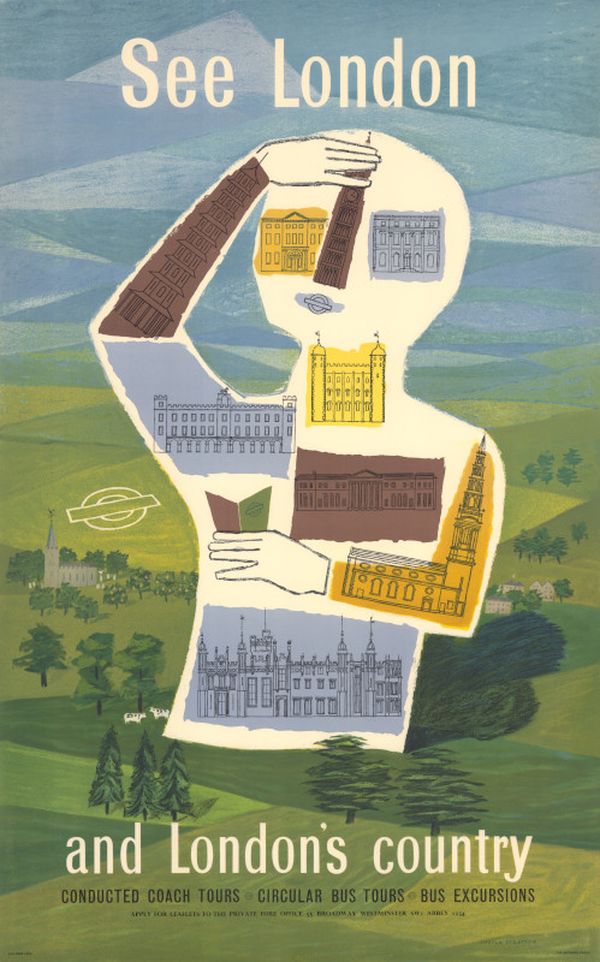
Of course, the vast majority of these posters were timetables, in tabular form without any artistic element whatsoever. However, LT filled unused spaces in the frames with other material, eg exhortations not to drop litter, to avoid rush hours, queue properly etc and, occasionally to advertise attractions which could be reached by bus. For some of these, an established artist would be employed.  Here area couple from my collection, both by Clifford Wilkinson – London’s Country Houses  from 1953 (triple A4 vertical)

Clifford Wilkinson vintage bus stop poster London's Country Houses 1953

and Windsor Castle from 1951 (double A4 vertical).

Clifford Wilkins vintage bus stop poster Windsor Castle 1953

The timetables have survived in reasonable numbers because bus enthusiasts have collected them but the “artistic” posters are quite rare survivors.

Other posters have been produced for interior use inside buses (above the seats). There are two standard sizes of these: 25″ x 8″ used from the 1930s until the present and a larger size (25″ x 11″) used on more modern types of buses. Below are a 1944 issue of the first type, by Midge,

Midge vintage bus poster 1944 help the conductor

and a 1976 issue of the second, by Harry Stevens.

Harry Stevens 1976 bus poster travel information

In addition, there were sundry-size posters for the buses in the 1950s-70s for specific panels, eg on the front bulkhead, above the front windows on the upper deck and on the staircase panel. Some examples of these:

Vintage Galbraith bus poster 1960 Please Help The conductor

A 1960 Galbraith – “Please help the Conductor” – 20″ x 9″

Vintage London Transport poster Galbraith bus Avoid Rush Hour Travel

A 1959 Galbraith – “Avoid Rush Hour Travel”  - 24″ x 5″

Anna Zinkeisen 1934 Aldershot Tattoo vintage London transport poster

A 1934 Zinkeisen – “Aldershot Tattoo by private bus” – 12″ x 10″

The 12″ x 10″ size was also used on the Underground from the 1930s until the 1970s. The Underground ones had a non-see-through backing, usually dark grey, because these posters were affixed to the glass vestibules by the train doors.

There are two other common sizes on the Underground: the cards which go in the carriages above the windows and the portrait type used on the escalators. I don’t have any “artistic” ones of either of these as they are largely used for commercial advertising.

All of which is comprehensive, brilliant and very much appreciated.  What’s more, he’s also very happy to answer any questions if you have any.  So thank you very much, Michael Wickham.

Posted in London Transport, posters | Tagged , , , | Leave a comment