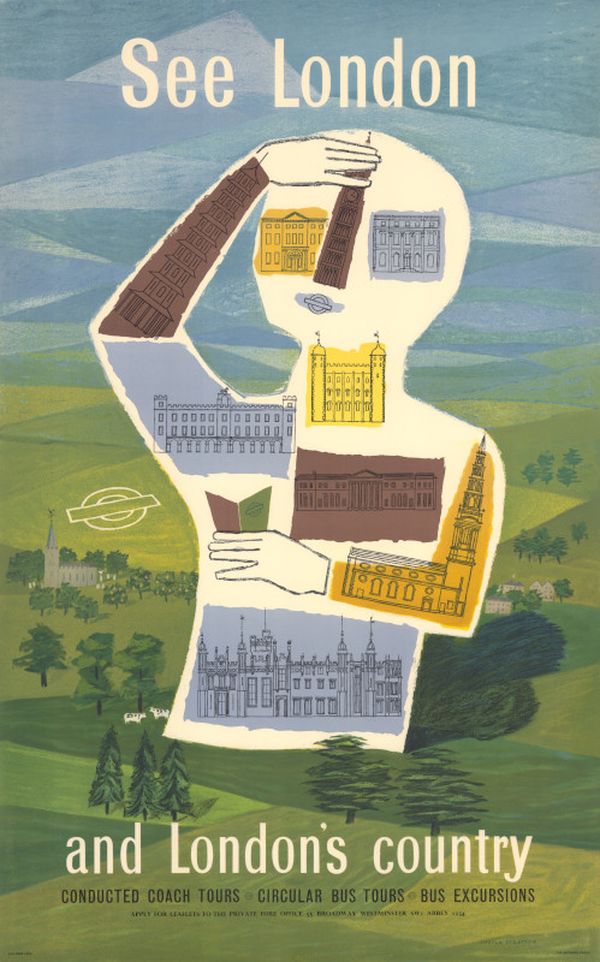
A life of surprises

Odd times indeed on eBay.  When I pointed out this poster last week, it was more for entertainment than investment value.

Ebay vintage anti-vandalism poster

But it went for £104.  Not so funny indeed.

I should have been less surprised that these two pieces of prime psychedelia went for £143 each.  They’re by the wonderful Dan Fern and printer-fresh.

Dan Fern Vintage Cadburys Crunchie poster 1960s

Dan Fern Vintage Cadburys Crunchie poster 1960s

Although Mr Crownfolio and I had harboured hopes of picking one up cheap, mainly because these are the kind of things which can fall through eBay searches un-noticed.  But not this time.  (There were another two, which went for under £40 each, but still not cheap).

This Daphne Padden also sold very quickly for a Buy It Now price of £50.

Daphne Padden vintage British railways poster packed lunch

I think I’d file that under interesting rather than desirable (much like the concept it’s advertising), mostly because it’s the first time I’ve ever seen that design and I had no idea that she had done much work for BR at all.  So there you go.

As for what’s on sale at the moment, it is, as ever, a mixed old bag.  Probably the most interesting are those being sold by medieval modernist, a name not unknown round these parts.  This Henrion is, how shall I put this, unlike anything else I’ve ever seen of his by quite a long way and then some.

Vintage henrion poster iconograda

If you find that a bit frightening, this Salter is slightly more conventional.

Vintage sAlter come to britain poster friendly policeman

And there’s plenty more in between, so go and take a look.

This poster wouldn’t be worth mentioning for itself, were it not for the person selling it.

Vintage war savings poster world war two propaganda

I’ve mentioned this story before, but  a seller on eBay, Kingchristopher, has been selling an incredible collection of leaflets, tickets, stamps, memorabilia and other ephemera for a very long time, all collected by his uncle George King.  A long time before this blog existed, we bought a number of 1950s and 60s GPO posters from him: apparently his uncle used to go into the Post Office and ask to have the posters they’d taken down each week.  Ones like this.

Tom Eckersley vintage GPO poster 1955

George King was clearly an interesting, if slightly obsessive man.  Mr Crownfolio recently found out a bit more about him from a philately forum:

George King who was one of the great Philatelic hoarders of our time, and a man truly ahead of his own time.
From about 1908 to the 1950′s (?) he posted envelopes to himself to obtain examples of virtually every new special event or special purpose postmark issued by the GPO in the UK. (TPO’s Machine Cancels Exhibitions, Skeleton marks etc etc). If you ever see his name on a cover do some more research.
Often the postmark will be the first day of use or the last day of use. He would often send half a doz or more covers and now these are often the only examples known. He also kept copies of virtually every Post Office leaflet and label issued and quantities of associated Shipping and aviation leaflets etc.
His accumulation must have filled rooms not just boxes and when it first came on the market, I believe in the early 1980′s, it was a real eye opener and helped establish the dates of issue of many TPO’s and provided examples of otherwise unknown marks.
Its a shame that the entire accumulation does not appear to have been recorded before sale. I know that the family had some problems, being let down financially by some of those involved.
Today I believe a family member still sells some of the original covers and leaflets on eBay etc. If you see a 1930′s Brit GPO leaflet in “looks like it was printed yesterday” condition chances are its ex. George King.
I heard a rumour that in WWI he was interviewed by the Secret Service to find out why he was writing to the postie in charge of every British and many Australian NZ and Indian Army Post Offices to obtain examples of their FPO postmarks!

None of my relatives were so forward thinking sadly, although I’m not entirely sure I would like to have inherited the job for life that disposing of it all seems to have become for his nephew.

Other than that, the theme seems to be 1950s kitsch.  This poster might be quite a nice buy were it not a) framed and b) in the States, so postage will be rather prohibitive.

Vintage 1950s British tourist poster for Redcar

This side of the Atlantic, you can have your kitsch in the form of tourism posters.

Vintage jersey tourism poster

Or commercial advertising.

eBay vintage card advertisement 1950s

Or simply way bigger than you really need.

very large vintage cigarette advertisement 1950s

That’s nine foot by six foot of big, so don’t say you weren’t warned.

Posted in eBay | Tagged , , , | Leave a comment

The forgotten man

I’ve said it before, and I will no doubt get around to saying it again, but Harry Stevens is a very underestimated poster artist.  That thought is mostly provoked by this 1954 poster, which we bought a copy of recently, (although one which I have to admit is slightly more battered than this picture).

harry Stevens address mail clearly vintage GPO poster 1954

It’s good, isn’t it?  And so’s this.

harry Stevens vintage southport coach poster 1950s

And indeed this.

Harry Stevens vintage east anglia coach poster 1950s

Mr Crownfolio wonders every so often whether that poster is Harry Stevens gently taking the mickey out of Daphne Padden’s sailor types.

2 x Daphne Padden Royal Blue vintage coach posters

Or perhaps fishermen were just picturesque visitor attractions all over the 1950s.  Who can say.

But back to Mr Stevens.  There are two things to say about him really.  One is that he is so thoroughly overlooked that there is very little out there on the web about him at all.  In fact pretty much the only biography I can find is that on the London Transport Museum website, and even that is pretty short.

The other is that he wasn’t overlooked at the time.  He regularly turns up in annuals of good taste like ‘Designers in Britain’ and, as the LTM biography says, won the Council of Industrial Design Poster Award in 1963.  So why is he so little known now?

It can’t be because his work has disappeared, beacause he has to be one of the most prolific poster artists of his generation, working right through into the 1970s.  This somewhat perplexing poster dates from 1971 for example.

Harry stevens male staff quite perplexing vintage ish gpo poster

He did quite a bit of this cartoon-style work for the GPO.  Some of it is as good as anything he ever did, like this owl from 1960.

Harry Stevens vintage GPO poster owl 1960

By the end of the decade, it goes get a bit repetitive and less appealing, probably just because he produced so many of the things.

Harry Stevens correct addressing cartoon poster GPO 1969

But don’t let that put you off his work, because he did do some really good posters too.  Perhaps some of his most adventurous designs were for London Transport.  Here are two he did in 1961 and 1963 respectively.

harry Stevens vintage London Transport poster 1961 Winter

Harry Stevens vintage London Transport poster Country walks 1963

But he could also do a much more graphic treatment for them too – I keep mistaking this particular poster for an Eckersley, although it does in fact date from 1976..

Harry Stevens vintage London Transport poster 1976

In terms of sale prices, even his later work is now starting to fetch higher prices and be sold by posh dealers, as I’ve mentioned before.

HArry Stevens litter vintage 1974 London Transport poster

But he’s still not really a name, and I do think this is an unfair omission.  Possibly he is just a bit too jovial for modern tastes. Then Tom Eckersley can tend that way too, particularly in the 1950s.

Stevens’ work definitely deserves better.  He was capable of producing a good poster right into the 197os.

harry Stevens vintage LT coach tour poster 1970

But for me, the posters he did in the 1950s and early 1960s are still some of my favourite things.  Interestingly, he seems to have done relatively few for British Railways – this Porthcawl is one of the very few  I can find.

Harry Stevens porthcawl poster vintage British Railways

Along with this artwork of yet another salty sea dog.

harry stevens vintage British Railways poster artwork 1955

In contrast, the coach companies kept him very busy indeed.

harry Stevens 1957 coach poster

Harry Stevens vintage coach poster

On the basis of those alone, he deserves to be better appreciated.

A final addendum, the London Transport Museum lists him as a designer and fine artist, but the only trace I have been able to find of the latter is this, ‘Spirit of Southern’.

Harry Stevens BR painting

The painting was commissioned by BR Southern Region in 1969 (not something that would ever happen now) but wasn’t very popular apparently and rarely got displayed.  But if anyone knows of any more artworks of his around and about, please do let me know as I would love to see them.

Posted in designers | Tagged | Leave a comment

A curiosity

Once again, found in the great warehouse of curiosities which is eBay.  It’s a Fitton, not a poster this time but a painting.

James fitton funny sketchy thing

And I’m pretty sure it’s the same Fitton too.  Certainly the signature matches those on the paintings in the Dulwich Art Gallery catalogue.

James Fitton signature

But even were it not signed, that acid green is reminiscent of the luminosity of the colours in quite a few of his posters  (although we almost certainly wouldn’t have found it on the great online jumble sale without a signature, I must admit).

James Fitton The Seen London Transport vintage poster 1948

James Fitton abbey Road poster

We paid a very small amount for it, and frankly you can see why, as it is a sketch, and a sketchy one at that, rather than a painting.  But having said that, I’m starting to become rather fond of the thing.  It looks best from a distance, an experience I can recreate for you here by shrinking it to a thumbnail.

And so, propped up on the highest shelf of the Ladderax, it works rather well.  The overall effect is one I rather like and generally tend to aim for, that of an impoverished 1950s architect trying to make the best of a slightly recalcitrant house.  And this might be a painting by one of the architect’s friends.  Well I can always pretend, can’t I?

Posted in designers | Tagged | 1 Comment

Mr Black will see you now.

I haven’t finished with exhibition design, not by a long way.  A copy of Misha Black’s Exhibition Design recently arrived in the post. He’s a much droller read than Beverley Pick – as well as designing some rather nice exhibitions too – so parts of that will definitely be appearing on here one of these days.

But in the meantime, that reminded me of Motif magazine, to be precise issue 4, because I photographed this ages ago and then left the results languishing.  For here is Misha Black himself, waiting to see us in his office.

Mischa Black in his office from Motif Issue 4 Edward Hughes

He’s writing about taste, style and the Industrial Designer, and I should probably read it thoroughly one of these days.  Although the essays of this period on the moral arguments for good design over popular taste are not among my favourite things, as they mostly tend to pontifications.  This issue of Motif is from 1960, though, so they are coming to the end of the the line; any moment now his arguments will be exploded by Pop.

The drawings, however, by Edward Hughes, are lovely.  Here is the miscellania on Misha Black’s shelves.

Misha Black's shelves, from Motif 4, Edward Hughes

It’s pretty good issue all round, really.  There’s an article on

Typography on buildings

featuring such delights as this.

type on building one

And this.

more type on buildings

Although Mr Tracy isn’t very impressed with the one above at all.

A plastic version of fat Bodoni italic: debased – the serifs have been thickened and the counters have been squared off – presumably to make the letters easier to produce.  This letter form has no relationship (either of harmony or contrast) with the wall surface or the architectural style of the building.

That’s them told.

Also in there are pearly kings and queens, illuminated advertising in Piccadilly Circus and antiquarian prints; truly there is something for everyone here.

But my favourite thing of all is the cover.

MOtif 4 cover Laurence Scarfe

It’s by Laurence Scarfe, who is clearly someone I ought to know more about.  Here’s the reverse.

Laurence Scarfe Motif reverse

We’ve just been offered some space to grow vegetables in, and that is what it is going to look like at the end of the summer.  For definite.

Posted in other | Leave a comment

Sax, vandalism and underwear

While eBay is still quiet after the holidays, there are a few things worth noticing up for sale at the moment.  Of which my favourite are these musical instrument posters.

Vintage 1940s musical instrument educational poster - Saxophone

There are nineteen of them altogether, and they were produced, so the listing usefully notes, between 1946 and 1949, with the editor of the series being the Director of Music for the Royal Military School for Music.  I’m guessing they were intended for schools, not least because they have the same format as the Shell Educational series, with integral black metal hangers at top and bottom.  They’re all good, but my favourite is this, the invisible man plays the tuba.

Vintage 1940s musical instrument educational poster - Tuba

They are all priced at 99p, and as things stand there isn’t a single bid on any of them, so a bargain awaits.

The other British offerings are more interesting for their historical curiosity than any aesthetic appeal.   The Fritter Fly must have been designed as a post-war successor to the Squanderbug, but never quite achieved the same fame.

Vintage 1953 savings poster Fritter Fly

Despite being lovingly framed, this has just failed to sell at £50, so you could always make the seller an offer.  Which is more than you might want to do with this one.

Ebay vintage anti-vandalism poster

Yet again, proof that the art of the poster was well and truly dead (and buried with the coffin fully nailed shut) by 1973.

Moving swiftly on officer, there are also a couple of items from outside our normal stomping grounds.  Shall we start with this painting?

Theyre Lee Elliott original painting

It’s by Theyre Lee Elliott, who produced wonderful posters before the Second World War, and then concentrated more on his paintings after that.  Just £49 if that’s your sort of thing.  Mine, it has to be said, is his posters.

Finally, a quick reminder that PosterConnection are still trundling along on eBay, selling industrial quantities of European posters in their shop.  Of the current stock, this Austrian design from 1954 is the one I like the best.

Vintage Knorr commercial poster chicken stock  Emil Neukomm from 1954

Even though I know that this, by Donald Brun, is probably a ‘better’ poster.

Vintage Cigar poster Donald Brun from 1964

Comedy award, however goes here.

Vintage Swiss underwear poster 1930

There’s something about the combination of the phrase Schutzmarke with underwear that my inner seven year old can’t resist.  Even though it’s not really funny at all. oh no.

Posted in eBay | Tagged | Leave a comment

Posters on Display

There was more to the Beverley Pick book than could fit into one single post. Ironically, what got left out last time was posters: to be precise their display, as demonstrated in this wonderful illustration by Mr Pick.

Beverley Pick wartime  poster display stand from display presentation book

It particularly jumped out at me because we have the poster at the bottom left, which I wasn’t actually certain was by Beverley Pick.

Beverley Pick photomontage world war two propaganda poster ministry of food small girl green vegetables

To be fair, the book doesn’t actually say it is either.  But given that every other photo in the book of Pick’s own work. it’s a reasonable assumption to make – and the photomontage and deep colour is very similar to his other poster work during the war.

BEverley Pick world war two propaganda poster ATS be useful

But the illustration of how these posters were displayed is worth a second look too.  Pick describes it as follows:

The light and portable poster screen shown here was designed to take seven posters of standard size and one headline streamer circulated at monthly intervals.

It’s a much more organised mean of display than I ever tend to imagine for Second World War posters.  More importantly, the experience of seeing seven posters together is very different to seeing one alone.  The single poster is much more like propaganda, just giving the viewer the idea that sowing winter vegetables is a good thing to do.  En masse, they are much more informative and give the viewer enough basic knowledge – which vegetables and when – to allow someone to go about it.

The display panel is a useful reminder that  posters appeared in more than one context, not only as solo propaganda pinned up on hoardings, in shops and on the walls of village halls but also in the more organised and didactic context of exhibitions too. It’s not something I’d really considered or read about before but having had that thought, the Imperial War Museum’s photo collection started to come in very useful.  Here’s their image of another poster much beloved of this blog.

F H K HEnrion posters on display off the ration exhibition London Zoo

This is, of course,  F.H.K. Henrion’s paen to the joys of rabbit meat, which  is on display as part of the Off the Ration Exhibition.

Entrance to Off the Ration Exhibition London Zoo

‘Off The Ration’ was originally held at London Zoo, which I always felt must have been a bit unnerving for the other animals, wondering how long it would be before they were designated as steak too.  No wonder that Lewitt Him’s kangaroo is feeding up the more likely candidates in the poster for the exhibition.

Lewitt Him off the ration exhibition poster 1943 Ministry of Information propaganda vintage poster

But returning to our subject of  the poster displays inside, I have seen both the posters at each end before now, but never the panel in the middle.  This may or may not have existed as a single poster – I have no way of knowing and even less means of finding out.  And were the Henrion posters commissioned for the exhibition first, or were existing posters incorporated into the exhibition’s design?  Again, I can’t tell you.

But these unanswerable questions are a useful reminder that posters during the war weren’t lone objects but were seen by people at the time as part of a whole range of other kinds of of graphic design – and the rest of it can easily be forgotten when we’re telling the story of the posters.

Take Potato Pete, as one of the more obvious examples.  He exists on posters, of course.

Potato Pete vintage world war two propaganda poster ministry of food

He too had his own exhibition, this time on Oxford Street (this looks like the site of the bombed-out John Lewis store which was used for a number of exhibitions during and just after the war).

Potato Pete exhibition

But many more people would have seen his image in the daily newspaper Food Bulletins put out by the Ministry of Food and so in many respects the posters and exhibtiions were just adjuncts of that.  So the poster was an image of an already well-known character, which meant that it would have been understood in a very different way.

The continuum of graphic design and display can work the opposite way round as well.  This woman in Oxford is finding out about salvage.

Ministry of Information Salvage exhibition Oxford

The displays that she is looking at aren’t, as far as I know, related to any particular poster campaign,although the main panel could quite easily pass as a poster design.  But nonetheless, people who’d seen this exhibition or one like it would read posters in a subtly different way, seeing them as just one part of what they were being told about salvage.  So perhaps posters had to say less, because they were acting as a reminder, or they were able to use visual symbols which would have been easily understood by the viewer because they’d already been explained in a different context.  It’s impossible to prove this, of course but equally it does seem absurd to thing that this overlap would not have happened.

None of this is in the slightest bit surprising to anyone who has any idea how advertising works in the modern world, where campaigns are planned across television, press and sometimes still posters, and now with social media added on too.  But these multiple contexts are very rarely considered in terms of wartime posters, even though the Ministry of Information was clearly a very shrewd and sophisticated user of all the means available to it.  And there were very many means indeed.  You might find a food exhibition in your local furniture retailer.

A view of a display by the Ministry of Food at the 'Domestic Front' exhibition held at James Brooke and Sons Ltd., 376 Bethnal Green Road. This display focuses on wartime cookery demonstrations and includes information on vitamins, dried eggs and vegetables.

More surprisingly, you might even catch an exhibition being driven down the street.

Travelling salvage exhibition outside Ministry of Information Bruce Angrave.

This highly covetable vehicle is a travelling salvage exhibition in 1943, and I shall let the Imperial War Museum describe it to you.

…the car has the words ‘Private Scrap is in town…come and meet him’ painted on the side. The van itself has a special bin for collecting books ‘for the forces, blitzed libraries, and salvage’, and the side of the van features a series of wooden display panels by artist Bruce Angrave. The salvage exhibition continues inside the vehicle.

Bruce Angrave’s panels aren’t posters and almost certainly don’t exist any more (and if someone wants to tell me I’m wrong on that, I’d very much like it). But they are part of the visual landscape that salvage posters inhabited, and so ought, even if just a tiny bit, to be taken into account when we talk about them.

When I studied Design History, I used to hate entirely abstract phrases like ‘visual culture’ and ‘discourse’; I’m hardly fond of them even now.  But they can have their uses sometimes.  Now that posters have become objects which are both valuable and collectable, the art-historical impulse tends to take over.  They are treated as ‘art’: framed and conserved, and displayed on their own.  None of this is wrong, but it can tend to leach into our thinking about them as well and that isn’t a good thing.  Posters are the bits of graphic design which were lucky enough to survive, but they were part of a much wider world of print and explanation, and it’s worth remembering that more often.


Posted in exhibitions | Tagged , , , , | Leave a comment